The 1960s, when Cocoa Beach grew 1,000% in ten years
Census data, motel construction, contractor in-migration, and what a barrier-island town does when its population goes from 246 in 1950 to 9,952 in 1970 because of a missile program.
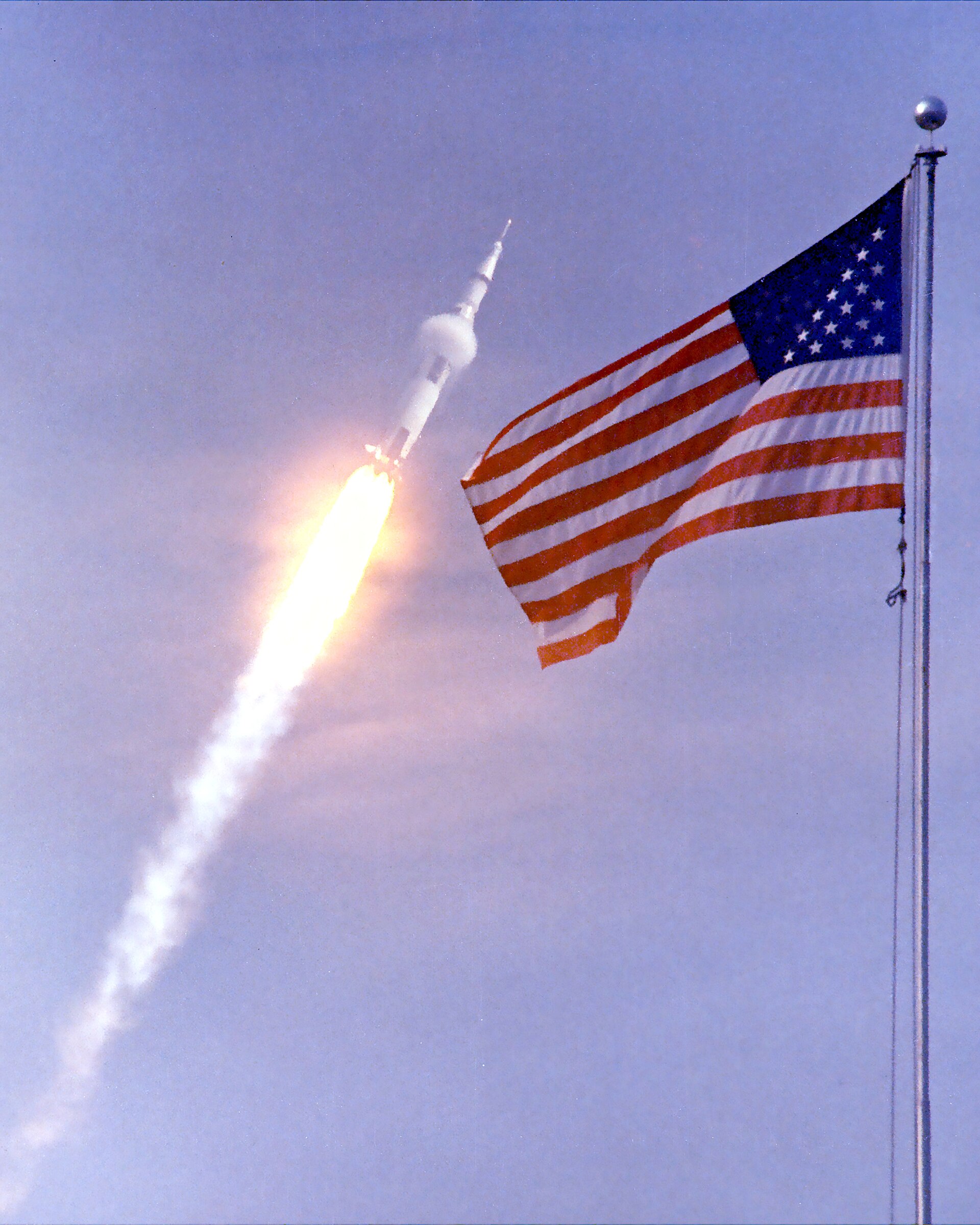
In 1950, incorporated Cocoa Beach had 246 residents. In 1960, it had 3,475. In 1970, it had 9,952. That’s a 40-fold increase in twenty years, more than half of it concentrated in the single decade of 1960–1970, when NASA’s Project Mercury, Project Gemini, and Project Apollo turned the barrier island into the residential annex of America’s manned space program. The U.S. spent roughly $25.4 billion on Apollo (about $260 billion in 2026 dollars per the Bureau of Labor Statistics CPI deflator), and a meaningful fraction of the contractor labor that money funded slept in Cocoa Beach.
The growth wasn’t gradual. It came in waves matched to NASA program milestones, and the building that survives today, the cinder-block motels, the kidney-shaped pools, the neon signs, is the architectural record of those waves.
Census waypoints
The hard numbers anchor everything:
- 1950: 246 residents (U.S. Census, Brevard County)
- 1960: 3,475 residents, 14× growth
- 1970: 9,952 residents, 2.9× growth on top of that
- 1980: 10,926 residents, the boom plateaus as Apollo ends
The 1960–1970 decade is the steepest part of the curve. Construction permits issued by the City of Cocoa Beach grew from a handful per year in 1955 to a peak in the mid-1960s coincident with the Apollo build-out. By NASA’s count, Apollo employed more than 400,000 people at its peak in 1966; the Cape Canaveral / Kennedy Space Center workforce represented tens of thousands of those, and roughly half of the local contractor workforce lived in Brevard County south of the Cape, disproportionately in Cocoa Beach and the new subdivisions of Merritt Island.
What the contractors did
The labor force that filled 1960s Cocoa Beach came in distinct categories:
NASA civil servants. Engineers and scientists employed directly by NASA, working at Kennedy Space Center, the Manned Spacecraft Center coordination office, and at Patrick AFB. Salaried, often relocated from other NASA centers (Langley in Virginia, Marshall in Alabama, JPL in California). Many bought single-family houses in Cocoa Beach proper or in the new Brevard subdivisions.
Prime contractor engineers. Boeing, North American Aviation, Grumman, IBM, McDonnell Douglas, Rocketdyne. These were the companies that actually built and integrated the Saturn V stages, the Apollo command module, the lunar module, the launch electronics. Their engineers rotated through Cocoa Beach for the duration of specific program phases. Some stayed years, some weeks.
Trade workers. Welders, fitters, electricians, machinists, instrumentation technicians. The blue-collar Apollo labor force, often union-affiliated, working at Kennedy or at the launch pads. They lived more often in rental housing, apartments, weekly motels, modest single-family houses on the mainland side.
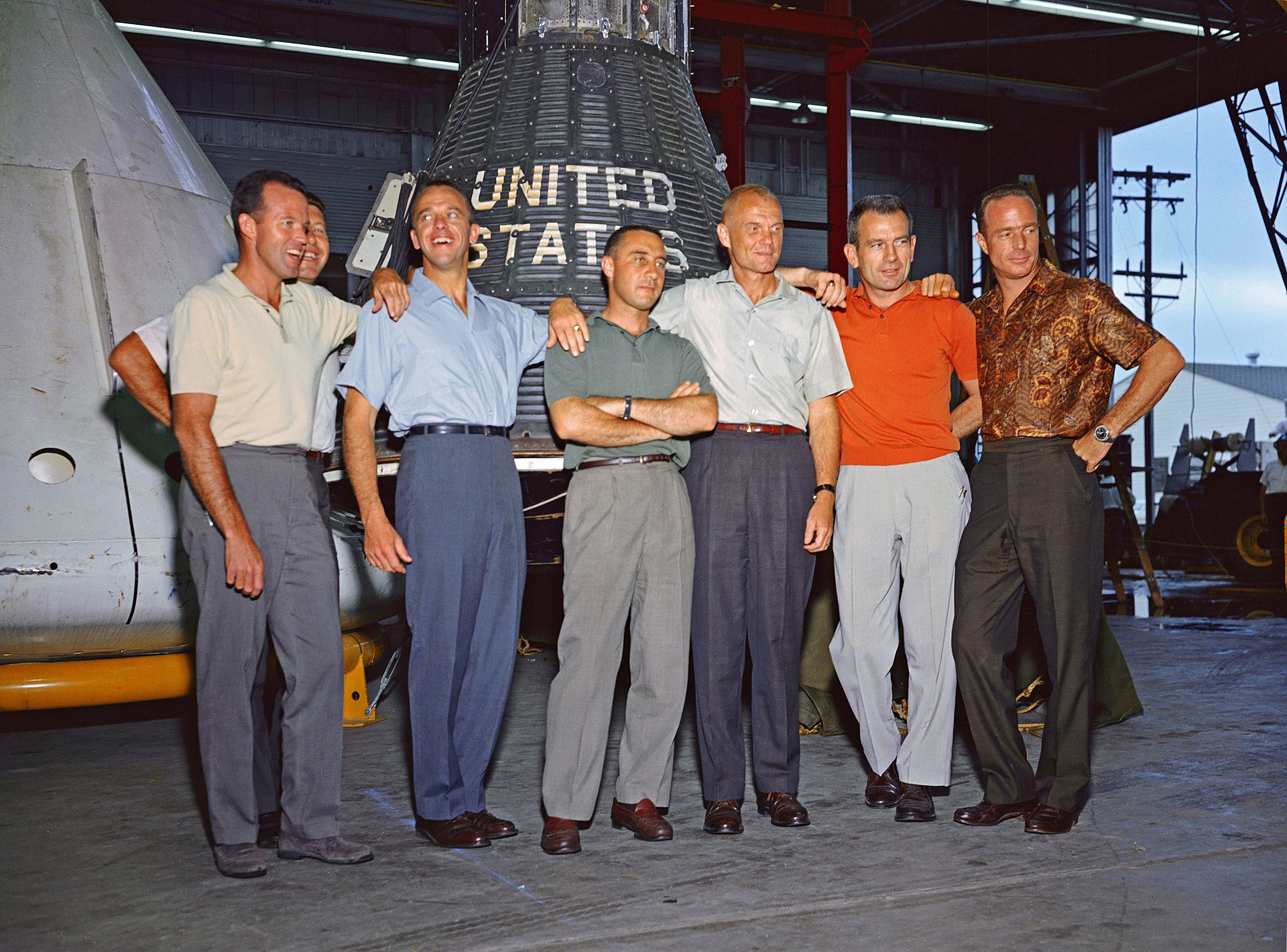
Test pilots and astronaut candidates. A small, visible minority. The Mercury 7, the Gemini astronauts, the Apollo astronauts all spent time in Cocoa Beach during training rotations. Most lived in housing arranged by the program; a few had personal residences in or near the town.
Combined, the contractor population during the peak Apollo years was tens of thousands in greater Brevard, of whom several thousand were Cocoa Beach residents. The city’s land area is roughly 5.6 square miles, so the density was real: contractor families packed into Cocoa Beach’s tight grid of platted lots, with new construction filling vacant lots faster than the city’s infrastructure could keep up.
The infrastructure scramble
A 1925 town charter and a 1950s road grid weren’t built for 10,000 people. The city spent the 1960s playing catch-up: water, sewer, schools, fire service, police, paving. Bond issues passed routinely. The 1925 charter’s taxing authority finally got exercised at scale.
Schools were the most visible scramble. Cocoa Beach Junior-Senior High School opened in 1965, four years after Alan Shepard’s first Mercury flight and four years before Apollo 11, because contractor families had kids and the kids needed somewhere to go beyond the bus ride to mainland Cocoa. (See: “Cocoa Beach High School and the Minutemen” for the school’s history.)
Water and sewer were the second scramble. The barrier island’s groundwater was brackish and saline below shallow depths; the town had to pipe in fresh water from the mainland and pump out sewage to mainland treatment. Pipe construction across the Banana River, paid for by bond issues secured against future tax revenue, ran through most of the decade.
The motel boom
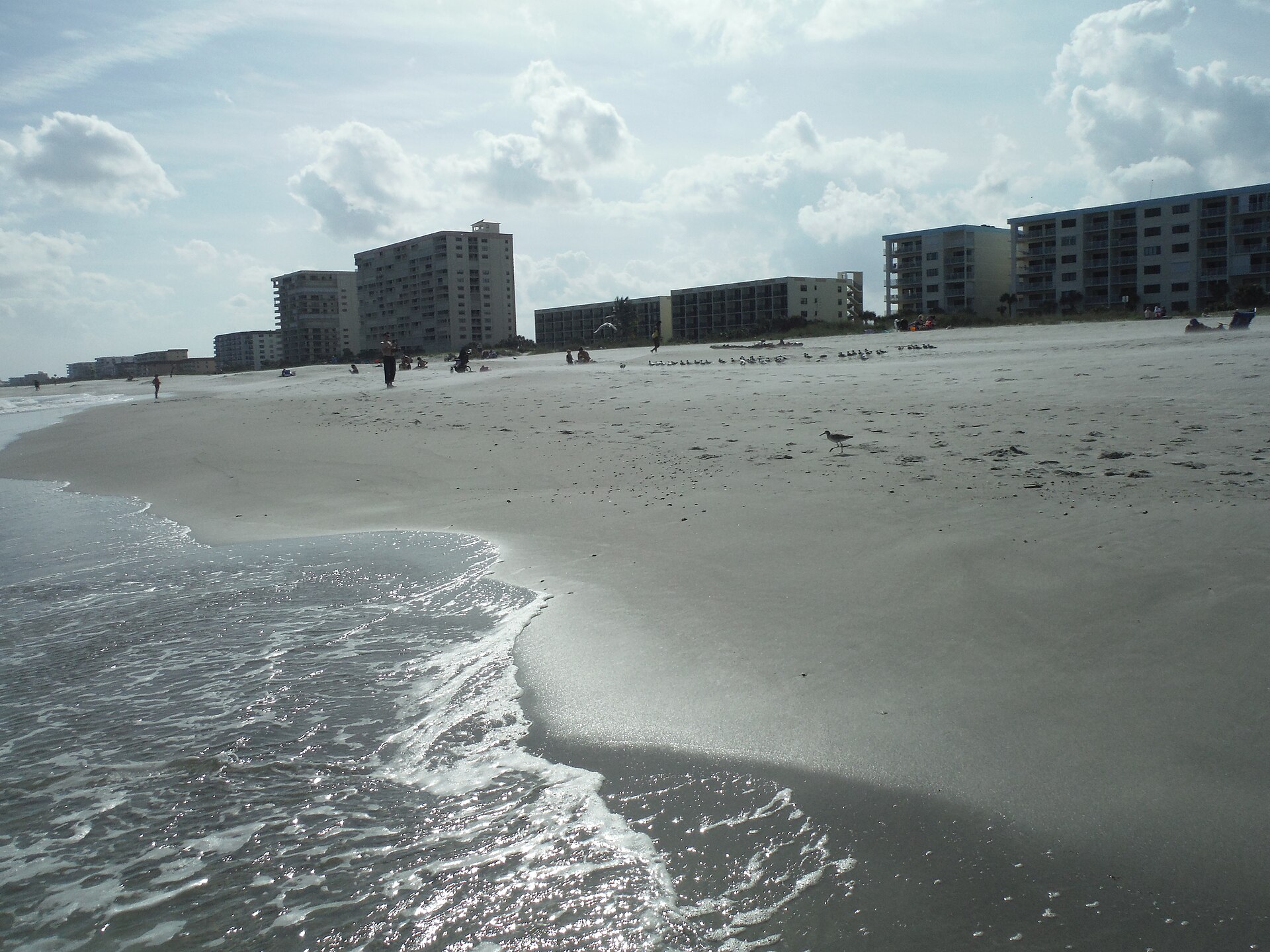
The most photographed legacy of the 1960s Cocoa Beach is the motel architecture. Between roughly 1958 and 1972, dozens of small to medium-sized motels opened along A1A and the side streets nearest the beach, in a regional vernacular that combined cinder-block construction, jalousie windows, kidney or rectangular pools, neon signage, exterior-corridor floor plans, and names (“Sea Missile,” “Vanguard,” “Polaris,” “Sky-Lab,” “Surf"") that played on the missile-and-spaceflight theme.
The Cape Colony Inn (now demolished), the Polaris (now demolished), the Vanguard, the Cocoa Beach Holiday Inn under Henri Landwirth, these were the architectural canvas of the era. Many are gone now, replaced by larger resorts, demolished for liability, or simply lost to time. The 1991 photographs in the Florida Memory archive captured many of them already on their last legs.
For a closer look at what survived and what didn’t, see “Mid-century motel architecture survey” and “The 1980s Cocoa Beach motel era”.
Apollo 11 and the peak
By the time Apollo 11 launched on July 16, 1969, Cocoa Beach had been operating at population maximum for two years. Every motel was booked. Every restaurant was packed. Bernard’s Surf, the Mai Tiki Bar, Ramon’s, the Bali Hai, the Cocoa Beach restaurants that had been astronaut hangouts for the Mercury and Gemini eras, were the busiest they would ever be. Estimates from contemporary Florida Today coverage put the Apollo 11 spectator population on the Brevard coast at roughly one million people for the launch, with Cocoa Beach and Cape Canaveral and Titusville and Melbourne all overloaded. The Pier was packed. The motels were renting parking spaces. The city’s police force had to direct traffic for two days.
(For the day-by-day account, see “The 1969 Apollo 11 launch and the million-visitor crowd”.)
What came after
The 1970s arrived. Apollo wound down. The last lunar mission (Apollo 17) flew in December 1972, four years before Kelly Slater was born on the island. The contractor workforce shrank fast, Boeing, Grumman, North American all closed or scaled back their Brevard offices. NASA pivoted to Skylab, then the long pre-Shuttle gap, then the Space Shuttle era starting in 1981.
Cocoa Beach’s population didn’t crash, but it stopped growing. The 1980 census showed 10,926 residents, only 1,000 more than 1970, on a much higher base. The 1990 and 2000 censuses both stayed in the same range. The 1960s decade was, and remains, the demographic peak of the boom.
If you walked Cocoa Beach in 1965 with a notebook, what you would have written down is: a city in fast-forward. New houses every week. New motels every quarter. New schools, new churches, new fire stations. By the time the decade ended, the place looked nothing like what Edwards had platted in 1923. The map was the same. Everything on top of it was new.
Further Reading
- The Right Stuff by Tom Wolfe
- Live from Cape Canaveral: Covering the Space Race by Jay Barbree
- Florida: A Short History by Michael Gannon
Sources
- U.S. Census Bureau, decennial census, Brevard County and Cocoa Beach municipality tables, census.gov
- NASA History Office, “Apollo by the Numbers”, history.nasa.gov
- City of Cocoa Beach, official history, cityofcocoabeach.com/197/History
- Florida Memory Project, photographic archive of 1960s Brevard County, floridamemory.com
- Florida Today archives (microfilm at Brevard County Library)
As an Amazon Associate we earn from qualifying purchases.