Cocoa Beach culinary history: Bernard's Surf, the Mai Tiki Bar, the long-gone places
Where the astronauts ate, where the Apollo crowd drank, and what's left of the 1960s Cocoa Beach restaurant scene. Bernard's Surf, Ramon's, the Mousetrap, the Mai Tiki Bar, and the half-dozen successors that still trade on the legacy.
The most famous restaurant in Cocoa Beach history was Bernard’s Surf, on A1A, opened in 1948 by Bernard Fisher, and the documented dining spot of the Mercury 7, the Gemini astronauts, the Apollo crew, the prime contractor engineers, the visiting journalists, and the steady-state local political class for roughly five decades. The second most famous was the Mai Tiki Bar, which started as a small adjacent operation and outlasted Bernard’s by years. The third was Ramon’s, a competitor that captured the second tier of the same astronaut-and-contractor business.
All three are closed now. Bernard’s closed in the early 2000s. The Mai Tiki Bar persisted in a modified form longer but has had multiple ownership changes. Ramon’s closed years earlier. The buildings that housed them have been variously demolished, redeveloped, or repurposed. What’s left is a thin layer of mid-century-themed dining trading on a legacy nobody who runs the current restaurants ever actually witnessed.
This is the documented culinary history.
Bernard’s Surf
Bernard Fisher opened Bernard’s Surf in 1948, in a modest A1A storefront in central Cocoa Beach. Fisher was a Florida restaurateur with prior experience in the South Florida seafood scene. He opened in Cocoa Beach betting on the post-war tourism growth that the new Banana River Naval Air Station (and later Patrick AFB and the missile-and-space program) would generate. The bet was correct.
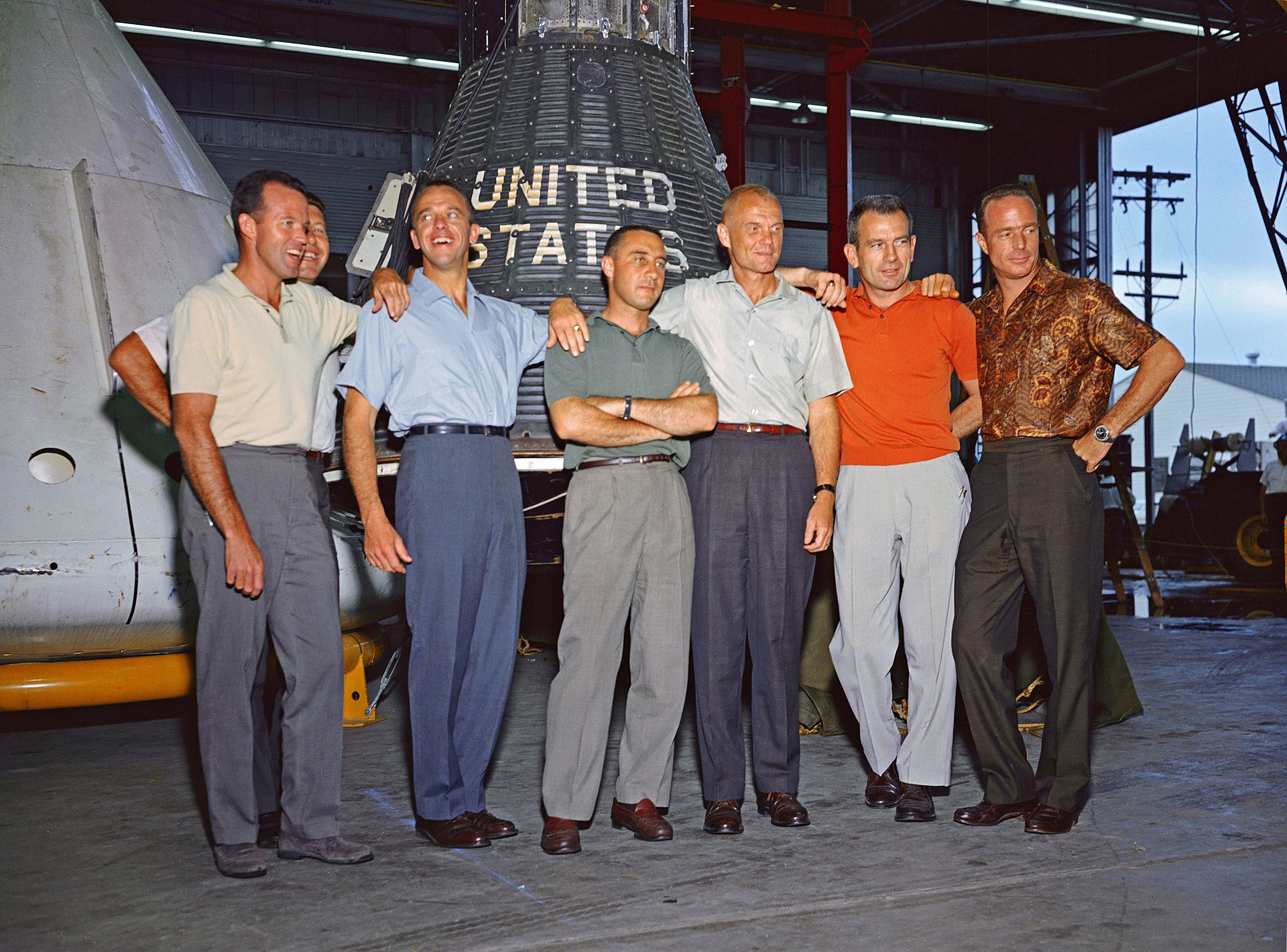
The original Bernard’s was a small steak-and-seafood operation with a modest dining room and a small bar. Through the 1950s the restaurant grew steadily on local and contractor clientele. By the early 1960s, with the Mercury program in full swing and the astronauts living and training in Cocoa Beach, Bernard’s became the documented astronaut dining room.
The restaurant’s atmosphere through the 1960s and 1970s, by contemporary accounts and surviving photographs:
- A multi-room layout with a main dining room and several smaller, more private dining spaces
- A bar that became the after-hours social center; Wally Schirra and Gus Grissom were regulars (Grissom’s friendship with Henri Landwirth across the street at the Holiday Inn made the route from the Holiday Inn bar to Bernard’s a short walk)
- Walls covered in framed astronaut photographs, autographs, mission patches, and memorabilia
- A staff that knew the astronauts personally and the press knew not to bother them
- Standard steakhouse-and-seafood menu, with shrimp, snapper, mahi, lobster, and the classic 1960s steak preparations
The Bernard’s astronaut collection, the framed memorabilia, grew into one of the more substantial private astronaut-artifact collections of its era. When the restaurant closed and the building was eventually sold, the collection was largely dispersed; some pieces ended up at the Astronaut Hall of Fame, some with private collectors.
Bernard’s closed in the early 2000s after several years of declining business under successor ownership (the Fisher family had progressively reduced its involvement through the 1980s and 1990s). The building has been demolished. The lot has been redeveloped.
Ramon’s
Ramon’s opened in the mid-1960s as a Mediterranean-and-seafood restaurant on Cocoa Beach, on A1A near central Cocoa Beach. The exact opening date is variously dated by surviving sources; mid-1960s is the consensus range. Ramon’s positioned itself slightly upscale of Bernard’s, with a more refined dining-room atmosphere and an emphasis on Continental cuisine.
The astronaut and contractor crowd at Bernard’s overlapped with the Ramon’s crowd. Some events that involved both establishments, the kind of multi-restaurant evenings that occurred during major launch celebrations, are documented in Florida Today coverage and in the recollections of contemporary Brevard residents.
Ramon’s closed in the 1980s or early 1990s. The building was sold and eventually demolished. The lot is now a parking lot or has been redeveloped.
The Mai Tiki Bar
The Mai Tiki Bar started as a small Polynesian-themed cocktail lounge in the 1960s and grew over the decades into a distinctive Cocoa Beach institution. The “Tiki bar” trope, Polynesian decor, rum-based cocktails, escapist beach atmosphere, was strongly associated with the 1960s American leisure culture, and Cocoa Beach’s version captured both the local astronaut-and-tourist business and the broader tiki-revival nostalgia in subsequent decades.
The Mai Tiki Bar operated continuously from the 1960s into the 2000s, surviving through multiple ownership changes, hurricane-damage events, and shifts in Cocoa Beach’s tourist mix. The bar’s atmosphere persisted recognizably from its 1960s origin: bamboo and rattan furnishings, hand-carved tiki masks, palm-frond ceiling, rum drinks served in carved coconut shells.
The Mai Tiki ownership changed several times. The original 1960s-era operation gave way to subsequent operators through the 1980s and 1990s. The bar has been documented in Florida Today coverage and in the broader tiki-revival press. Whether the current 2026 establishment using the Mai Tiki name is “the same bar” is a matter of definitional preference; the physical building has been substantially modified, the staff is entirely new, and the ownership is multi-generations removed from the founders.
The Mai Tiki Bar’s most-photographed contemporary version is in the location near the Cocoa Beach Pier, which combines several mid-century-themed tiki-bar elements with the modern pier-adjacent tourist environment.
The Mousetrap, and the lesser-known places
The Mousetrap was a smaller bar near Bernard’s, documented in Mercury-era recollections as a regular astronaut after-hours stop. The bar’s name reportedly came from the cramped interior layout (a mouse-trap-like sequence of rooms). It closed in the 1970s or 1980s and the building was demolished.
Hudgey’s, The Beachcomber, The Cap’n Loui’s, and several other Cocoa Beach restaurants of the 1960s and 1970s operated alongside the major three (Bernard’s, Ramon’s, Mai Tiki). Most were smaller, more specialized, and less famous; most have closed.
The 1960s Cocoa Beach restaurant scene was, in aggregate, larger and more diverse than the surviving institutional memory suggests. Florida Today archives from the 1960s and 1970s document dozens of Cocoa Beach restaurants in operation, Italian, Cuban, seafood, steakhouse, breakfast, lunch counter, bar-and-grill. The vast majority of them have closed without leaving documentary or building footprint.
The 2026 culinary scene
Cocoa Beach in 2026 has a culinary scene roughly comparable in size to its 1970s peak, though qualitatively different. The current restaurant mix includes:
- Chain restaurants along A1A and at major intersections (the standard mid-tier American chains plus several Florida-regional chains)
- Independent seafood restaurants on the pier and at scattered locations on the barrier strip
- Cuban and Latin restaurants, reflecting the increased Hispanic population in Brevard County
- Sushi and Asian-fusion restaurants, reflecting general tourist-dining diversification
- Beach-themed casual restaurants trading on Cocoa Beach surfing and astronaut culture
- Coffee shops including several local independents and the standard national chains
Notably missing from the 2026 mix is anything quite like Bernard’s at its peak, a long-tenured, locally-owned, multi-decade restaurant with documented celebrity-clientele history. The closest analogues are the pier-end restaurant operations and a handful of long-standing independent steakhouses, none of which has the same cultural-anchor function.
The astronaut-themed marketing remains active. Several current Cocoa Beach restaurants reference the Mercury and Apollo eras in menu names, decor elements, and marketing language. None of them was actually open during the Mercury or Apollo eras. The astronaut culinary legacy is preserved in marketing, not in restaurants.
If you want to eat where Wally Schirra ate, you can’t. The building isn’t there. If you want to eat where Cocoa Beach has positioned itself as the astronaut town, you have a dozen options trading on the legacy. The distinction matters for the historically curious. For most diners it doesn’t.
Further Reading
Sources
- Florida Memory Project, Brevard County restaurant photographic series, floridamemory.com
- Florida Today archives, restaurant and entertainment coverage 1960 to 2020 (Brevard County Library)
- Henri Landwirth, Gift of Life, 1996 memoir (covers Holiday Inn-Bernard’s relationship)
- Smithsonian Air & Space, astronaut social-history features
- Brevard County Property Appraiser, parcel records for redeveloped restaurant sites
As an Amazon Associate we earn from qualifying purchases.