Beach renourishment in Cocoa Beach: the recurring federal investment
How Cocoa Beach has been pumping sand back onto its eroding beach since the 1990s. USACE projects, FDEP cost-share, and the structural reality that the barrier strip would lose its tourist value without continuous federal renourishment.
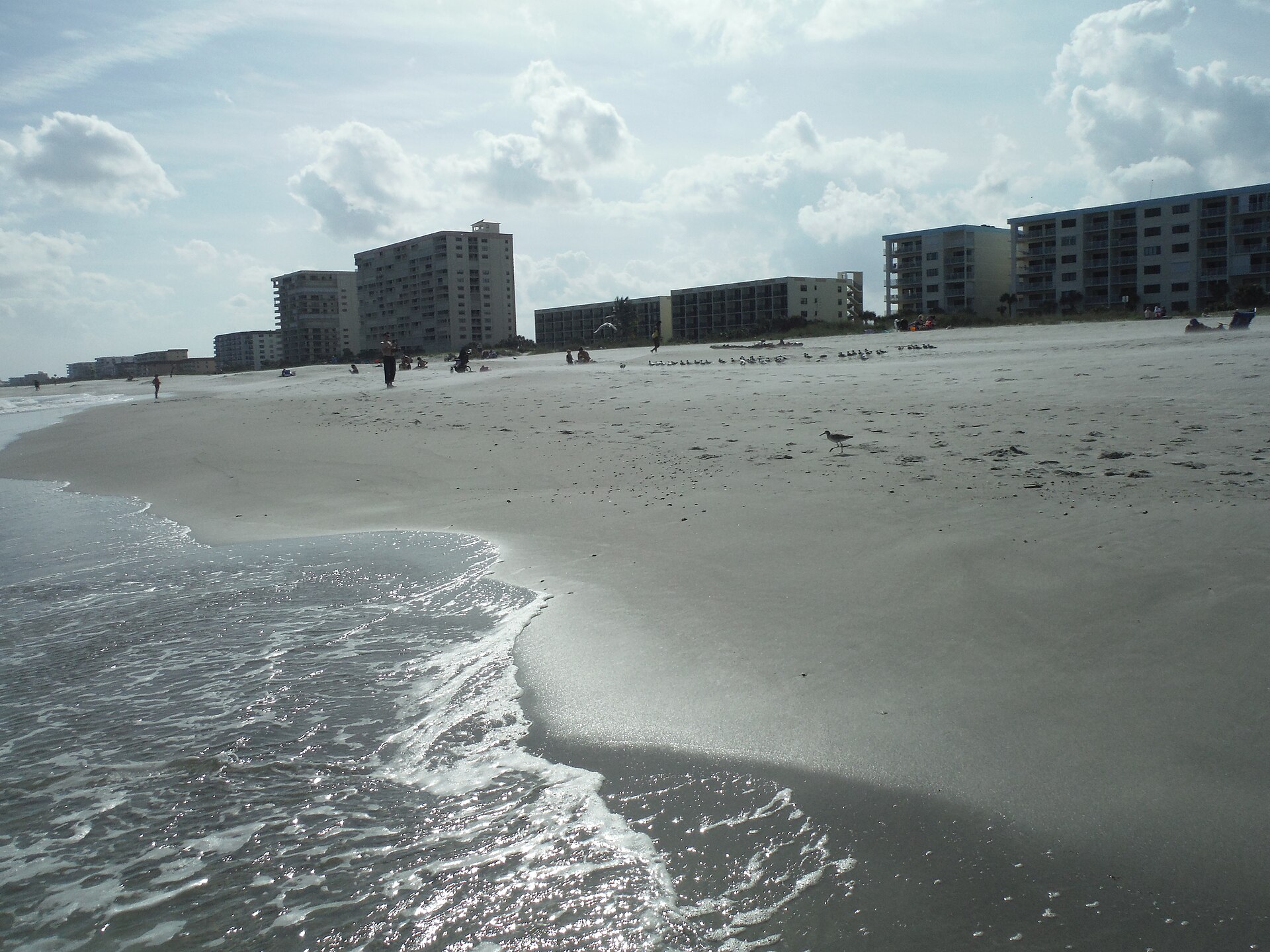
The wide sandy beach you walk on in Cocoa Beach in 2026 was, in significant fraction, dumped there by Army Corps of Engineers dredges. The Cocoa Beach barrier strip has been the subject of repeated federally-funded beach renourishment projects since the early 1990s, with multiple major sand-placement events totaling tens of millions of cubic yards of sediment moved from offshore borrow areas onto the active beach. Without the renourishment, the natural rate of erosion, accelerated by hurricane impacts, sea-level rise, and shoreline-armoring effects from upstream, would have stripped the beach down to a narrow sliver against the dune line. The town’s tourist economy, real-estate values, and storm-protection capacity all depend on continued federal sand placement.
This piece documents the project history, costs, mechanics, and ongoing challenges.
Why Cocoa Beach erodes
Cocoa Beach is a barrier island fronting a shoreline that has been retreating, on average, since the end of the last Ice Age 10,000 years ago. The natural sediment budget on Florida’s Atlantic east coast is northbound longshore drift, sand moves north along the coast under wave action, with sand “exporting” the system through inlets to the south and “entering” the system from offshore sources to the north. The Cocoa Beach barrier strip in particular is downdrift of Port Canaveral, whose jetty system (built in the 1950s) interrupted the natural sand supply.
Combined effects:
- Port Canaveral jetties trap northbound longshore sand on the north side, depriving Cocoa Beach of the natural updrift sand supply
- Sea-level rise of roughly 8 inches over the past century, accelerating in recent decades, has produced a baseline erosion rate
- Hurricane impacts (1979 David, 2004 Frances/Jeanne, 2016 Matthew, 2017 Irma, 2022 Ian/Nicole, see Cocoa Beach hurricanes) periodically erode the beach in discrete events that the natural recovery process can’t fully reverse
- Inlet bypass operations: Port Canaveral’s sand-bypass system, when operating, captures some of the trapped sand and moves it south past the jetties to renourish downstream beaches, but the bypass has never fully matched the natural pre-jetty supply
Combined, Cocoa Beach loses, on average, several feet of beach width per year without intervention.
The Brevard County Shore Protection Project
The Army Corps of Engineers Jacksonville District authorized the Brevard County Shore Protection Project in the late 1980s. The project’s federal cost-share structure typically runs 50 to 65 percent federal, with the balance from state (FDEP) and local sources. The project area covers most of the Brevard barrier strip, including Cocoa Beach proper, with separate “reaches” engineered to address specific erosion patterns.
The first major renourishment event for Cocoa Beach proper occurred in 2001, placing approximately 3 million cubic yards of sand on the beach. Subsequent placements:
- 2006: post-2004 hurricane recovery, several million cubic yards
- 2014: scheduled maintenance, large placement
- 2018: post-Matthew/Irma recovery, scheduled placement
- 2023–2024: post-Ian/Nicole emergency recovery, the largest single placement in the program’s history at approximately 10 million cubic yards of sand across the Brevard barrier strip
Total federal investment in the project from 1993 through 2025 exceeds $400 million in nominal dollars (significantly more in 2026-inflation-adjusted dollars).

How a renourishment works
A typical Cocoa Beach renourishment uses trailing suction hopper dredges working an offshore borrow area. The borrow area, located several miles offshore in water depths of 30 to 60 feet, is a sand deposit that has been geophysically surveyed and approved for use. The dredges suction sand-and-water slurry from the borrow area into the hopper, transit to the placement area off Cocoa Beach, and pump the slurry through a floating pipeline to a beach-level discharge.
The discharged sand spreads naturally and is shaped by bulldozers into a designed beach profile. The new profile includes:
- A wider berm (the flat upper beach above high tide), often 50 to 100 feet wider than pre-renourishment
- A constructed dune line with planted dune vegetation (sea oats, railroad vine, sea grape)
- A more gradually sloping intertidal zone that dissipates wave energy
A typical Cocoa Beach renourishment project takes several months to complete, with continuous dredge operation, beach-access restrictions, and night-time work to meet timelines. Sand placement is typically scheduled for fall and winter to avoid the May-October sea-turtle nesting season.
Sand quality and source
The borrow-area sand used for Cocoa Beach renourishment is fine-grained quartz sand roughly matching the native Cocoa Beach beach sediment. Color, grain size, and mineral composition are all matched to the native conditions as closely as possible. Quality control is an ongoing concern: a 2006 project drew complaints because some of the placed sand was darker and finer than native sediment, producing a temporary visual mismatch that took several seasons to weather to match.
Source areas are rotated to avoid depleting any single offshore sand deposit. The Brevard County offshore sand resource is finite; long-term sustainability of the renourishment program depends on continued availability of suitable borrow sites.
Costs and who pays
The project’s funding structure has shifted over time. Federal cost-share traditionally ran 65 percent for “shore protection” projects, falling to lower federal percentages for “recreational beaches” or “non-storm-damage-reduction” components. The Brevard County program has generally qualified for the higher federal share because the beach provides documented storm-damage-reduction benefits for upland infrastructure.
State (FDEP) and local (Brevard County, sometimes municipal) shares cover the remainder. Cocoa Beach specifically has, at various times, contributed local-funding shares through tourist-development tax revenue. Federal authorization for the program runs through specific Water Resources Development Acts (WRDA), which Congress passes every several years to authorize Corps of Engineers projects.
Per-cubic-yard costs run from roughly $15 to $25 in 2026 dollars, varying with project size, dredge availability, fuel costs, and borrow-area characteristics. A 5-million-cubic-yard placement therefore costs $75 million to $125 million.
The structural reality
Renourishment doesn’t stop erosion. It pushes the cliff edge back by widening the beach, but the underlying erosion process continues. The placed sand gradually moves north (longshore drift), offshore (storm losses), and onshore (windblown). The beach narrows again. The cycle repeats.
What renourishment buys is time. A renourishment placement adds, on average, five to ten years of effective beach width before another placement is needed. Hurricane impacts can accelerate the timing, a single major storm can wipe out half a renourishment in a single weekend. The 2024 placement, for instance, was needed earlier than the planned schedule because Ian and Nicole had stripped the 2018 placement faster than projected.
Without renourishment, the Cocoa Beach beach width would, by current engineering estimates, reduce to approximately 10 to 30 feet (versus 100 to 200 feet renourished). At that width:
- Oceanfront properties would lose storm-surge buffering and face accelerated structural damage
- The Cocoa Beach Pier would sustain more storm damage per event
- Real-estate values would drop significantly across the oceanfront market
- The tourism economy would collapse over multiple seasons
- Beach access for daily public use would be substantially constrained
The federal investment in renourishment is, in cost-benefit terms, a comparatively cheap insurance policy against those losses. The economic impact assessments published by FDEP and the Corps consistently show benefit-to-cost ratios above 2:1 for the Brevard program.
What’s next
The Brevard County Shore Protection Project’s federal authorization runs through future WRDA reauthorizations. As long as Congress continues to authorize the program and the appropriations process funds it, renourishment will continue.
The longer-term challenges are real:
- Borrow-area sand depletion: the offshore sand resource will eventually run out. Future placements may need to source sand from farther offshore (more expensive) or from inland mines (much more expensive)
- Climate change: accelerating sea-level rise increases the placement frequency needed to maintain a given beach width
- Federal budget pressure: Corps of Engineers civil-works appropriations face periodic budget reductions; the Brevard program competes with other Florida and national projects
- Hurricane frequency: if Atlantic hurricane activity continues to trend upward, placement schedules will compress
None of these is immediate. The Cocoa Beach renourishment program is reasonably solid for the next decade. Beyond that, the calculations get harder. But the underlying reality, that Cocoa Beach is a barrier island that requires continuous sand reinforcement to remain a tourist beach, isn’t going to change.
Further Reading
- The Gulf: The Making of an American Sea by Jack E. Davis
- Florida’s Hurricane History by Jay Barnes
- Florida: A Short History by Michael Gannon
Sources
- U.S. Army Corps of Engineers, Jacksonville District, Brevard County Shore Protection Project, saj.usace.army.mil
- Florida Department of Environmental Protection, Bureau of Beaches and Coastal Systems, floridadep.gov/water/beaches-coastal-systems-bureau
- Brevard County Natural Resources Management, brevardfl.gov/NaturalResources
- Water Resources Development Acts (WRDA), congressional authorization records
- Various USACE Environmental Impact Statements for Brevard renourishment placements
As an Amazon Associate we earn from qualifying purchases.