The Mercury 7 in Cocoa Beach
Where America's first astronauts lived, drank, and trained between launches. The Holiday Inn under Henri Landwirth, the Cape Colony Inn, Bernard's Surf, and the local culture that surrounded them between 1959 and 1963.
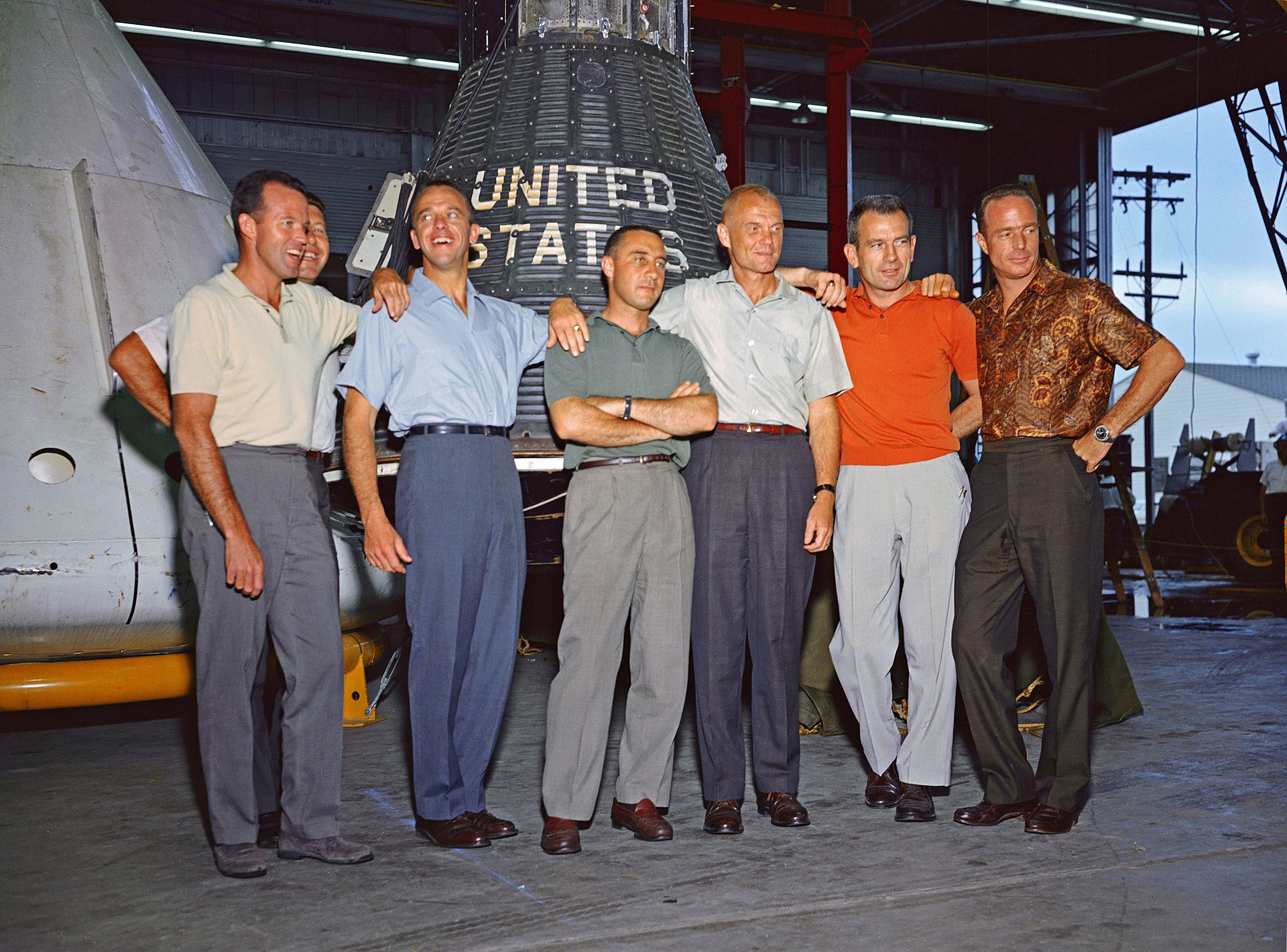
The Mercury Seven, Alan Shepard, John Glenn, Gus Grissom, Scott Carpenter, Wally Schirra, Gordon Cooper, Deke Slayton, were selected on April 9, 1959 and announced at a Washington press conference the same day. From that moment until Cooper’s final Mercury flight in May 1963, the program ran out of two places: NASA’s Space Task Group at Langley Research Center in Virginia, and the launch facilities at Cape Canaveral, Florida. The astronauts split their time between the two. When they were at the Cape, they were in Cocoa Beach. And when they were in Cocoa Beach, the documented record places them, repeatedly, at three addresses: the Cape Colony Inn, Henri Landwirth’s Holiday Inn, and Bernard’s Surf.
Tom Wolfe’s The Right Stuff (1979) is the most-cited account of this culture, and Wolfe is good on the atmosphere but selective with the documentation. The piece below pulls from NASA’s program records, Landwirth’s own memoir, contemporary Brevard County journalism, and the actual addresses, dates, and people involved.
Where they slept
Most of the Mercury training rotations through Cocoa Beach were short, a few days to a week at a time, built around centrifuge sessions at the Aero Medical Laboratory, simulator runs at the Cape, and pre-flight preparation phases in the days before specific launches. NASA didn’t house the astronauts in dedicated quarters at first. They put them in commercial motels.
The Cape Colony Inn, run by Henri Landwirth before he took over the Cocoa Beach Holiday Inn, became the regular bookings address in 1960. Multiple Mercury-era documents and recollections place the seven there in the spring and summer of 1960, often in adjoining rooms, with NASA picking up the tab.
In 1961 Landwirth moved to manage the Cocoa Beach Holiday Inn, and the astronaut bookings followed him. By the time of Alan Shepard’s May 5, 1961 Mercury-Redstone 3 flight (the first American manned spaceflight), the Holiday Inn was effectively the unofficial astronaut headquarters. Landwirth, a Holocaust survivor who had grown up in Belgium and Poland and arrived in America in 1950, became close personal friends with several of the astronauts, particularly Gus Grissom. The friendship is documented in Landwirth’s 1996 memoir, Gift of Life, and in subsequent reporting by Florida Today and Smithsonian Air & Space.
The Holiday Inn building is gone now. The lot it sat on, on A1A in central Cocoa Beach, has been redeveloped multiple times since. The Cape Colony Inn was also lost to redevelopment.
Where they ate
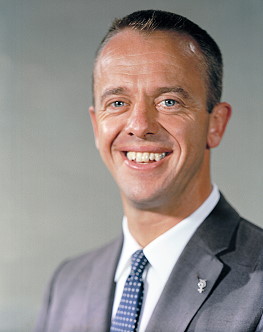
Bernard’s Surf, opened in 1948 by Bernard Fisher, was the documented Mercury astronaut restaurant. Located on A1A in Cocoa Beach, Bernard’s was a steak-and-seafood place that grew into a multi-room operation, attached a bar that became the social center of the local space scene, and by 1962 was known nationally as the place where you might walk in and find John Glenn at a corner table. Glenn ate there. So did Shepard. So did Grissom, Carpenter, Schirra, Cooper, and Slayton, on rotation.
Bernard’s added a “space bar” with framed astronaut autographs along the walls. The collection grew through the 1960s and into the Apollo era. The restaurant remained an astronaut hangout into the Shuttle era, eventually closing in the 2000s after a long decline. The building has been demolished. A plaque at the site notes its history.
Other documented Mercury-era food spots: the Mousetrap (a small bar that hosted post-launch celebrations), Ramon’s, the Vanguard motel restaurant, and a handful of mainland-side restaurants in Cocoa proper that the astronauts visited less often but reliably.
How they trained
The Cape Canaveral Aero Medical Laboratory and Hangar S, the Mercury operations building on the Cape, were where the actual technical training happened. The astronauts ran daily simulator sessions, suit-fit checks, capsule-egress drills, and physical conditioning at the Cape. They drove from Cocoa Beach to the Cape each morning, a roughly twenty-minute drive up A1A, and back each evening.
Pre-flight, the routine tightened. The launch astronaut moved into Hangar S’s astronaut crew quarters in the final days, isolating from the others to minimize illness exposure. Family members typically stayed in Cocoa Beach motels. The morning of launch (Shepard, 5 a.m. wake-up on May 5, 1961; Glenn, 2:20 a.m. wake-up on February 20, 1962) the launch astronaut left from Hangar S directly, not from Cocoa Beach. The other six watched from Cape grandstands or from designated observer positions in Cocoa Beach if they weren’t in the recovery chain.
How they drank
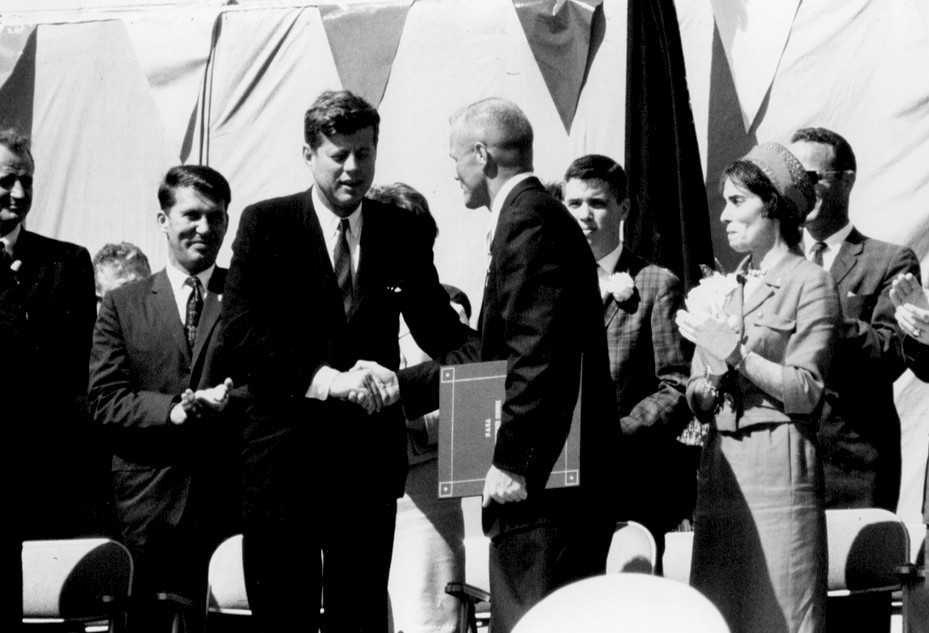
The Mercury Seven drank. This is the part Wolfe is most accurate on. Off-duty, after the day’s training, they assembled at Bernard’s bar or at the Holiday Inn or at the Mousetrap. The astronaut culture inherited from the test-pilot community at Edwards Air Force Base and Pax River carried over: hard-driving, hard-drinking, fast cars, late nights, with the implicit but real understanding that anyone who couldn’t perform the next morning would lose their flight.
The relationship between the astronauts, the local bar culture, and the press was an unwritten compact. Local journalists at Florida Today (founded 1966 as a Brevard daily, but its predecessor Cocoa Tribune covered the early Mercury years) and at the national outlets writing on the program saw a lot. They reported almost none of it. The astronaut-as-American-hero brand that NASA, Life Magazine, and the broader space-race propaganda apparatus needed depended on the astronauts looking like family men in clean flight suits, not bar regulars at Bernard’s. The local press understood that and kept the off-duty material quiet.
The compact mostly held through the Mercury era and broke down progressively through Gemini and Apollo. By the early 1970s, post-Apollo, several astronauts gave interviews acknowledging the lifestyle. Wolfe synthesized it into The Right Stuff in 1979. By then everyone involved was at least middle-aged and most of the implicated bars were closing.
What the relationship gave Cocoa Beach
The Mercury 7 spent maybe a third of their actual program time in Cocoa Beach. The remaining two-thirds was at Langley, in training facilities elsewhere, on travel, or on launch sites in Florida that weren’t the town itself. But the third they spent there was enough to give Cocoa Beach a permanent association with the program. The Holiday Inn-Bernard’s Surf-Cape Colony loop became the documented social geography of the first American astronauts.
What Cocoa Beach gave back was a place where the astronauts could be people. Not test subjects, not heroes, not the next launch, just men in their thirties getting a steak and a beer with their training crew, in a town where a few hundred year-round residents knew their names and didn’t make a production of it. That arrangement lasted from 1959 through about 1964. After that, the Apollo program scaled up, the tourist crowds arrived in numbers, the press camp grew permanent, and the quiet astronaut-town era ended.
Six of the seven Mercury astronauts have died: Grissom (Apollo 1 fire, January 27, 1967), Shepard (leukemia, July 21, 1998), Slayton (brain tumor, June 13, 1993), Cooper (Parkinson’s disease and heart failure, October 4, 2004), Carpenter (October 10, 2013), Schirra (heart attack, May 3, 2007), and Glenn (December 8, 2016, age 95). Landwirth died on April 15, 2018. The buildings they sat in are mostly gone. The town remembers.
Sources
- NASA History Office, “Project Mercury Documents”, history.nasa.gov
- Henri Landwirth, Gift of Life, 1996 memoir
- Tom Wolfe, The Right Stuff, Farrar Straus Giroux, 1979 (secondary, atmospheric)
- Florida Today archives, Brevard County Library system
- Smithsonian National Air and Space Museum, Mercury collection, airandspace.si.edu
Further Reading
As an Amazon Associate we earn from qualifying purchases.